I intend to write a longer review of Haider, but I will wait to watch it once more at least, on DVD to write a full review. That will also allow me to discuss the plot without spoiling the movie for whoever reads the review. To put in short Haider is a gem, may even be VB's best, but I will reserve the judgement till a second viewing of the film. Vishal Bharadwaj in my opinion has been able to capture the true essence of the great Shakespearean tragedy of Hamlet. Now I am no expert on Shakespeare, but you don't need to be one to assess why Hamlet is considered as one of his more tragic, if not the most, of all his tragedies. And Haider validates that feeling, with an omni present aura of impending gloom and dread through out the movie. 15-20 minutes into the film you will start getting a feel that this story is not going to end well, and the more you watch the feeling gets worse. And that is VB's towering achievement. He was able to create that sense of doom & despair with not just the expressions on the characters' faces, but with superb cinematography and a brilliant background music. Kashmir's landscapes looked at once beautiful, dangerous and depressing through cinematographer Pankaj Kumar's (Ship of Theseus) lenses. I also came to know that the screenplay is jointly written by VB and Basharat Peer, a famed journalist who wrote the book Curfewed Night on Kashmir. Haider has several incidents from that book. The acting was superb by everyone, including Shradhha Kapoor, but Shahid Kapoor was the one who stood out. The story was about Haider's mental turmoil, and Shahid Kapoor managed to look every bit as troubled & tormented as he was supposed to be. His deterioration from an innocent and calm young boy to a delirious and dangerous man consumed with revenge was meticulously scripted and deftly portrayed by Shahid himself. Some scenes stand out - like the one where he is standing at Lal Chowk Srinagar, with his head shaven, and speaking to a moderate crowd through a megaphone - "Hello, hello 1 .. 2.. 3 mike testing, awaaz arahi hai ...". Or the one where he ponders on whether "to be or not to be (revengeful)" with a gun in his hand. The dialogues were very well written too, some of them I believe translated as is from the original play. Haider's complex relationship with his mom was also very well written as it was central to the plot. I will not discuss the story, I will leave it for later. To sum up Haider is a must watch, for connoisseurs of cinema. Go watch it if you haven't already.
A blog mostly about reviews of films and books, because that's what I do best. But occasionally I have also penned my thoughts on general subjects.
Saturday, 21 February 2015
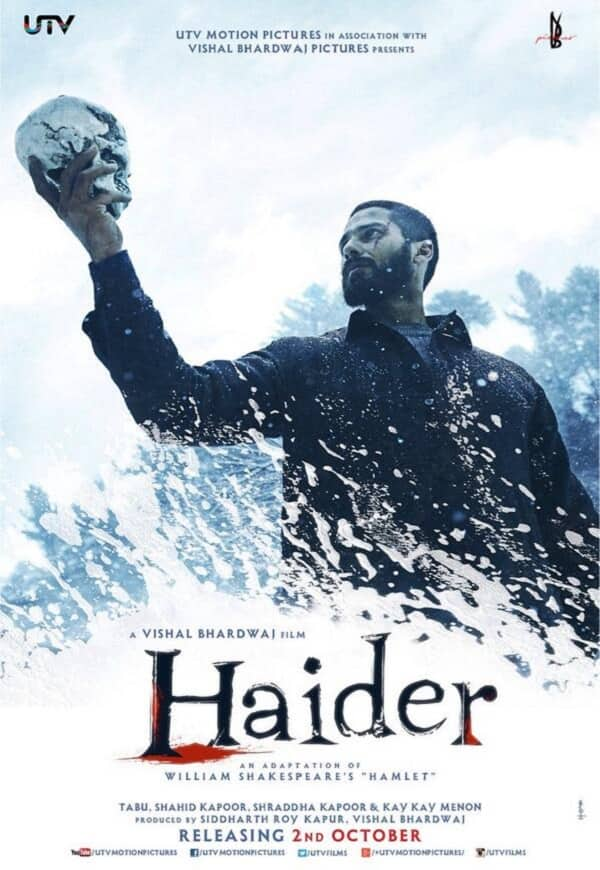
Haider - a short review
I intend to write a longer review of Haider, but I will wait to watch it once more at least, on DVD to write a full review. That will also allow me to discuss the plot without spoiling the movie for whoever reads the review. To put in short Haider is a gem, may even be VB's best, but I will reserve the judgement till a second viewing of the film. Vishal Bharadwaj in my opinion has been able to capture the true essence of the great Shakespearean tragedy of Hamlet. Now I am no expert on Shakespeare, but you don't need to be one to assess why Hamlet is considered as one of his more tragic, if not the most, of all his tragedies. And Haider validates that feeling, with an omni present aura of impending gloom and dread through out the movie. 15-20 minutes into the film you will start getting a feel that this story is not going to end well, and the more you watch the feeling gets worse. And that is VB's towering achievement. He was able to create that sense of doom & despair with not just the expressions on the characters' faces, but with superb cinematography and a brilliant background music. Kashmir's landscapes looked at once beautiful, dangerous and depressing through cinematographer Pankaj Kumar's (Ship of Theseus) lenses. I also came to know that the screenplay is jointly written by VB and Basharat Peer, a famed journalist who wrote the book Curfewed Night on Kashmir. Haider has several incidents from that book. The acting was superb by everyone, including Shradhha Kapoor, but Shahid Kapoor was the one who stood out. The story was about Haider's mental turmoil, and Shahid Kapoor managed to look every bit as troubled & tormented as he was supposed to be. His deterioration from an innocent and calm young boy to a delirious and dangerous man consumed with revenge was meticulously scripted and deftly portrayed by Shahid himself. Some scenes stand out - like the one where he is standing at Lal Chowk Srinagar, with his head shaven, and speaking to a moderate crowd through a megaphone - "Hello, hello 1 .. 2.. 3 mike testing, awaaz arahi hai ...". Or the one where he ponders on whether "to be or not to be (revengeful)" with a gun in his hand. The dialogues were very well written too, some of them I believe translated as is from the original play. Haider's complex relationship with his mom was also very well written as it was central to the plot. I will not discuss the story, I will leave it for later. To sum up Haider is a must watch, for connoisseurs of cinema. Go watch it if you haven't already.
Sunday, 9 November 2014
Interstellar Review
This review contains spoilers. So if you haven't watched the movie don't read it.
I have always been a fan of Space Operas. Floating through vast stretches of nothingness is a singular experience, I may never know that feeling for real but I am content with the virtual cinema experience. But making a good Space Opera is no mean feat. The visual effects and the technology have to be meticulously crafted to give an authentic feel. I can think of only a handful of films that have done that successfully. Kubrick's 2001 is of course at the top of the list, followed by Alfonso Cuaron's Gravity and Danny Boyle's Sunshine. And then Nolan decided to make Interstellar to reset the queue. Interstellar does complete justice to the word Opera, in fact it sets the bar quite high for future space films to reach. Nolan transported me to a hitherto unknown and unseen world from which I did not want to return. There were some breathtaking shots of Saturn's rings, the blackhole called Gargantua and mile high tidal waves that made me want to leave my planet and go on a space voyage. This was the most visually enhancing space experience I have had till date, and just a year back I had thought that Gravity would be difficult to beat ...
Let me give you a brief recap of the story. Sometime in the future the earth gets afflicted with Dust Storms and crop failures. There is food scarcity world over and the dust has become a permanent feature of everyday life. The American Govt has shutdown NASA as the need of the hour is farming and food production and not space research. And to drive the point further, the Govt has modified science textbooks to teach kids that the 1969 Moon Landing was fake, done just to rattle the Soviet Union and increase their space budget !! I loved this part. Coop (Matthew McConnaughey) is a retired NASA pilot who like everyone else is a corn farmer now. He lives with his 2 children and father-in-law. Coop's daughter Murph has an imaginative mind and she believes there is a ghost in her room who throws books from the shelves. Coop after ignoring her daughter for a while one day actually observes strange phenomenon in that room himself, but being an engineer he is able to understand that Murph's ghost is actually a gravitational anomaly. And one day that anomaly leads Coop and Murph to a secret underground location where NASA is still active. He meets his old professor Dr Brand (Michael Caine) there who tells him that this planet is not meant to be saved, its meant to be left. NASA, or whatever is left of it has been secretly working on a mission to find other inhabitable worlds where humanity can be moved to save them from extinction. To help them in their quest "they" most likely extra-terrestrial beings from a higher dimension have placed a wormhole in our Solar System near Saturn that allows you to jump through space-time to another galaxy far far away where there could be earth like planets. NASA has already sent 13 manned missions through this wormhole out of which they have been getting promising signals from 3. They ask Coop to pilot one last flight to save humanity, travel to these 3 planets and find a new home for mankind. If a suitable planet is found there are 2 plans to save mankind - Plan A where Dr. Brand will figure out a way to take the entire population of the earth to this new planet. And that would involve unlocking the secrets of gravity and jumping into another dimension. Plan B was to send some frozen fertilized human embryos with Coop's mission who would enable humanity to grow once again after everyone on earth are wiped out in case Plan A fails. Coop is to be accompanied by 3 scientists in his flight, one being Dr Brand's daughter Amelia (Anne Hathaway). Murph doesn't want to let her father go as she is scared he may not return, but eventually Coop leaves promising her that he will return 1 day. Coop and 3 others then set out for their journey into outer space, they travel through the wormhole and explore 3 planets one by one, the last of which becomes humanity's next destination.
A lot of things happen during Coop's space adventure which I have omitted for brevity's sake. Some of it made scientific sense and some didn't. As the film progressed the science became more and more obscure and slightly difficult for the layman to follow. Unfortunately there were some glaring mistakes in Interstellar's science which Phil Plait (an astronomer himself) has written about here. That's surprising considering that renowned astro-physicist and black-hole expert Kip Thorne was a consultant for this film. I suggest you to read Phil Plait's blog to understand all the scientific errors he has mentioned. I personally feel a science fiction book/movie is allowed to take liberties with the science to a certain degree, if it serves the story's purpose but I was shocked/confused by 2 points which I will mention here and which Phil Plait has also mentioned. It was too high a leap of faith that Nolan was asking me to take, and I wasn't prepared for it -
- 2 planets revolving around a giant black hole which are considered habitable with organic matter. Where did they get the heat and light from? Black holes are known to absorb all sorts of energy from their surroundings.
- How did Coop manage to cross the event horizon and enter the black hole? His space shuttle should have been fried or torn to pieces when he attempted that. Even if I consider that the tesseract built inside the singularity was to protect him from disintegrating but I am confused how he even reached there. Although this part was central to the film's plot, maybe that's why Nolan just decided to go with it.
- And I am adding a 3rd here as a bonus. The dialogue where Amelia compares love to a higher dimensional entity, something that we don't fully comprehend because we don't understand higher dimensions and hence dismiss as irrational. Duh ... I didn't like it.
And then there was the question of "they". The film implied that "they" were actually not higher dimensional beings but humans from the future who had unlocked the mysteries of higher dimensions and hence had built that tesseract inside the black hole which Coop uses to communicate with his daughter in the past. I thought a lot about this, and I am still confused. It's an example of the Bootstrap Paradox or the Ontological Paradox, a term frequently used in context with Time Travel. This trick has been used in several sci-fi films/books before, doesn't make it any less mind boggling. More details here.
The scientific glitches aside Interstellar's message was loud and clear, and that for me was the winner!
The message was two fold -
- The first was that human beings are capable of doing anything to survive, sitting and waiting to die is just not us. In a way Nolan was urging the scientific community to strive harder and explore the vast uncharted Universe, although we aren't faced with any imminent danger right now, but who knows what future has in store. If we want we can do it. Maybe all that we need is a leap of faith. True that Chris Nolan. I am with you on this. All the greatest discoveries in science have been leaps of faith - take relativity for instance. To this day people are overawed by it. Just because one crazy guy (Albert Einstein) had the vision and courage to take that leap of faith.
- The second message isn't a new one but nevertheless a classic - love and human connection transcend the boundaries of space and time. A father will do whatever it takes, travel through black-holes, jump dimensions and what not to keep the promise he made to his daughter.
All in all Interstellar makes for one experience which will remain with you for a long long time. I am planning to watch it again, and again and again ...
Monday, 1 April 2013
The rightful package
Recently I was offered a big (big is a relative term) amount
as pay package from a software company. While
I am still in the process of deciding whether to take up the offer or to wait
and look for other better offers, I thought it was worthwhile devoting some
time to pondering on this question which has been on my mind for some time – “How much an employee should be paid?” A
question whose answer every company needs to decide before hiring. But a
company’s answer to this question maybe driven by selfish reasons, and each
company’s decision will differ from others’.
Hence to answer this question objectively we will need to put more
thought to it. This essay is an attempt to finding an answer to this question,
through an objective analysis of facts ... well as objective as possible. I am
not an expert in economics, so my musings may not be economically correct, but
I am an observer of my country and my times hence I will try to look for an
answer from that point of view. Also since I have observed the Indian software
industry more closely than any other, my observations and theories will hover
around the same.
I think the question of The
Rightful pay package can be broken
down into 2 parts –
- How much does one deserve (to be paid)
- How much does one need (to maintain a reasonable lifestyle)
The second question is much more difficult to answer than
the first, and I doubt if it is ever considered by organisations in the real world
while deciding pay packages for employees. While the first question is more
likely to elicit unbiased and reasonable responses, the second question is
bound to succumb to subjective definitions of the word reasonable. Hence I will tackle the easier question first. But
before trying to look for answers it would be appropriate to give a bit of a background.
The Indian software
Industry - Since the 90s there has been a boom in software jobs in India.
So much so that a software professional’s life has become kind of synonymous
with the good life. Some people may disagree with my view, because often we s/w
engineers have been called cyber coolies and there is a section of people who
think exactly the opposite – that a software engineer’s life is a bad life. I
would say although this view exists, it’s in minority. I believe the
predominant view among the middle class is that software jobs are good and
software professionals lead comfortable and affluent lives. The primary reason
for this belief is the salary that software engineers draw and the percentage
of them living abroad. In India the biggest attraction towards a software job
has been its onsite opportunities or in layman terms the opportunity to work
abroad especially in the US. This has over the years also resulted in an
incorrect belief in the minds of people (who are not part of the s/w industry)
that the s/w engineers living or working abroad are surely better than those
that are working in India. This is not necessarily true, most software engineers
know it, but I will not digress into this discussion. With more and more
software jobs appearing in the market due to globalisation and the
profitability of outsourcing, the software engineer’s salary has been
constantly on a rise. This is also perpetuated by rising inflation and a
growing trend of consumerism in the cities. But a software engineer’s handsome
pay package has a little more to do with than just industry demand.
Hiring* - While
people in the software industry like any other industry are recruited based on
their skills and expertise, their salaries are not always proportionate to
their abilities. More often a software engineer’s salary is determined by his
previous salary and his ability to bargain (for more). Hence a secret mantra
(now no longer a secret) of earning more in the s/w industry is to keep
switching jobs. A person who has worked for more companies in a given period of
time invariably earns more than a person who has stuck with one company for the
same duration. This system I believe is grossly wrong and discriminating. A
person’s salary should be only proportional to a combination of his abilities
and years of experience, irrespective of how many companies he has worked for
or how well he can bargain. This system has led to glaring inequality in
salaries across the software industry and is being wrongly taken advantage of
by companies and employees alike. Most companies often do not bother to raise
the salaries of their employees more than a minimum percentage, unless they resign
and bargain for a raise. While the same companies will pay a new lateral
employee much more than what they pay to an existing employee with same skill
sets and experience. Another not so palpable evil of the system is that, it has
made people greedy. As some wise man
said – “A raise is a raise for just about 1 week, after that it’s just your
salary.” This leads to an insatiable desire to earn more, it’s never enough. One
is bound to ask the question then, why do some people keep working for the same
company for years at a stretch at all? Although the number of people working
for the same company for more than 5 years is quite less, but there is a good
number of people who stick with a company for 3-5 years. There are a number of
reasons for that –
- People are not adventurous. They are happy with the status quo and don’t want to make the effort to go and look for other jobs.
- Some people value job security more than a high pay package. This is seen more among the experienced people with families. Joining a new company has its share of uncertainties; some people don’t want that uncertainty in their lives.
- Some people, although a small percentage are actually happy with their jobs and salaries and see no reason to change.
Here I have not counted those people who are not good enough
to qualify/clear job interviews, they are holding on to their existing jobs by
virtue of having been worked there for some time.
How much does one
deserve? - But I have not yet answered the question – “How much does one
deserve?” There is no standard answer to this question even if we limit our
jurisdiction to the software industry. I am not sure how a person’s
contribution to a project/software can be quantified, but if there was some way
to do that reasonably this question could be answered. I am sure companies have
some justification and thought behind the salary structures they design for
different levels of employees, but I feel that justification maybe less
rational and more prejudiced. I will cite a personal example here. In my last
project I worked with a very talented and knowledgeable fresher (he was an
M.Tech though). My package was roughly 3 times his. If I take out the value-of-experience
factor, there was not much difference between his contribution and mine to the
project. If anything he was probably a better Java developer than me and some
others in the team. But just because he was a fresher he had to be content with
a modest package. I took this simplistic example because I could feel the
disparity closely in this particular case, the criteria for deciding the
salaries of higher management maybe more complex and to quantify their
contribution to the company more difficult. To sum up, I feel if a person is
being paid more than what his/her contribution to his/her company/project
deserves, he is being overpaid.
How much does one
need? - Now coming to the question of - “How much does one need?” or to put
in other words “How much is enough?” It’s a question frequently asked by
environmentalists and socialists and deliberately ignored by capitalists. The
definition for “enough” is relative; it is different for different classes of
people. Since we are talking about salaries here, I think any salary that lets
a person and his/her family maintain a decent and comfortable standard of
living and provides for all the necessities, should be enough. But here is the
problem. It is probably wrong to expect a person to continue maintaining the
same standard of living throughout his life and not strive to improve it if he
can. Along with that an economy following this kind of model is bound to become
stagnated and sooner or later plummet into recession. Hence answering this
question is considerably more difficult than the first. I have personally
experienced that the “enough” is often defined by the limits to my spending
capabilities. When I earned 15k per month, it was enough for me; I adjusted my
lifestyle to manage within my salary limits. I paid less rent and lived in a
modest house, I had a relatively cheap mobile, I used to watch morning shows at
PVR in the weekends and bought less clothes and accessories. But this was 5
years back. Goods and services have become dearer since then. To maintain the
same sort of lifestyle I would probably need 25k now. But not withstanding the
effects of inflation, I have managed to increase my expenditure constantly with
my rising income, and in the process I have discovered – “It’s never enough.”
Part of the blame for this realization goes to my ever increasing desires and
part of it goes to the rampant consumerism that modern India is experiencing. It’s
no longer just about providing for oneself and one’s family, it’s about showing
off one’s power of spending.
In a country where the disparity between the poor and the
rich is so huge, where 32 % of the population is below the poverty line but 11
Indians feature in the Forbes list of richest billionaires, and the richest
among them decided to flaunt this disparity by building a 27 storied house
maintained by a 600 member staff just for his family; I find this trend
disturbing. But then what is the solution? The only solution I can think of is
Govt. Regulation over salaries and spending. But that would make us socialists!
I am not sure if living in a socialist economy would be worse than living in a
capitalist economy. The entrepreneurs and industrialists who have lived through
the age of the License Raj would have something to say about that for sure.
I would end this discussion here. I have reached the limits
of my knowledge on the matter and my thinking abilities. I don’t think I
provided any convincing answers to the questions I raised. Hopefully with time
I will be able to refurbish my answers and present a more formidable case.
*hiring in other industries is probably done in the same
manner but I am not aware of that hence I will confine my discussion to the
software industry only.
Wednesday, 27 March 2013
Coriolanus - movie review
Coriolanus is one of the lesser
known of Shakespeare's plays, which debutante director Ralph Fiennes
(by no means a stranger to Hollywood has adapted into a film, with
some interesting changes. The movie is set in what looks like modern times -
with TV news channels, mobile communication, modern arms and ammunition; but
the language used by the protagonists is Shakespearean. Let me repeat this - Shakespearean. That's what
makes the movie a difficult watch, it takes some time to get used to, but in
general I could only comprehend about 40% of the dialogues. But never the less,
the story is not difficult to understand. Coriolanus is the story of a military
general Caius Martius(Fiennes) from a city that calls itself Rome, he
is anointed with the title of Coriolanus for defending his city
against the attack of the Volscian army led by Tullus Aufidius (Gerard Butler)
in the battle of Corioles, but when Coriolanus runs for the post of Consul his
pride and a general condescending attitude towards the people of the City of
Rome lead to him being banished from the city. Coriolanus then vows revenge
against the city whose loyal servant, he once was.
I will not
give any more of that story out. Ralph Fiennes delivers a powerful performance,
his expressions and his dialogue delivery gave me goose bumps. Ralph Fiennes
has proved to the world again and again what a brilliantly versatile actor he
is, his array of work probably is as diverse as it can get - the ruthless nazi
in Schindler's List, the shy husband in The Constant Gardener, the hesitant and
troubled man in The Reader, The menacing Voldemort in Harry Potter and now
Coriolanus. Pity that he has been nominated for Oscar twice, but hasn't bagged
one yet.
Vanessa Redgrave playing the role of
Coriolanus' domineering mother also does justice to her character. One cannot
but appreciate the work put in by the whole cast, to memorize the
difficult dialogues and then deliver them with elegant poise.
There is an amount of willing
suspension of disbelief expected of the audience to be able to appreciate the
movie. After all its an adaptation of a play written more than 400 years
ago. But all in all I would still say, a Saturday night well spent.
The great Indian censorship dream
I don't understand this furore over censorship in social media. We have been pioneers of censorship ... always !! We ban controversial movie and book releases all the time. And we don't even need the Govt for that. Any Tom Dick Harry with a few strong muscular followers can do that any day and then assume some fancy name for their new formed group and formulate some ideology for themselves (coz ideology is required ... Ohh you've got 2 stand 4 something).
Worst case if Facebook and youtube is censored, the fun that we have by abusing and criticizing politicians ... well we would have to find some new pastime. There are plenty available in FB anyways !!
I don't think Facebook will be banned though, there are a lot of companies whose main source of advertisement is Facebook, I am sure they won't let that happen.
Censorship has always been a feature of our politics - as the Americans invade any country in the interest of national security, we censor anything in the interest of communal harmony. After all we have been neighbors to China for so long, we ought to learn something from them, good or bad.
I don't feel angered at Mr Sibbal at coming up with such an outrageous idea of social media censorship, I don't think its outrageous at all ... at least not in India. What I am disappointed with is the cliched and hackneyed thinking on the part of the IT minister to take control over a dire situation. Any other minister in his position, no matter from which party he belonged, would have done quite the same thing ... or done nothing. If the Govt thinks that social media is fueling a lot of distrust and anger in the citizen's mind, what has the Govt done to build that trust back? Why can't they use the same social media to counter all those opinions ... Maybe they don't have anything to counter them with, maybe they don't have anything to show off now ...
The Govt has already given up I feel, they themselves don't want to continue ... the kind of mismanagement they have shown in the past few months ... might encourage B Schools to create a new course in their curriculum called - How not to manage (The Congress Way). If the majority party can't have a hold over the parliament's proceedings, how could you expect them to do well in governing the country !!
For all those who are reading this note (that's a big assumption on my part) and thinking whose side this guy is anyways? Well ... I am just a regular pessimist, I don't have to pick sides ... I just happen to know some English and like to show off my writing skills occasionally :)
How different is our faith in science, from our faith in religion?
Picked the following exceprt from a book review of Geek Nation by Jaimon Joseph in ibnlive.in.com. I really liked the view point hence sharing it.
How different is our faith in science, from our faith in religion? We accept what scientists tell us, it's not like we're doing any experiments to cross check their claims. Ditto, for what pundits and priests dole out for us. For better or worse, our modern belief system is still based on TRUST, not on science, no?
That's why when scientists tell us nuclear power is safe, we believe them. Because after all, they are the brightest bulbs around. When scientists tell us the glaciers are melting, we believe them too. After all, who has the time to take a thermometer to the South Pole!?
It's only when a Fukushima happens, or when newspapers offer up the inside dope on what climate scientists are REALLY emailing each other about - that we do a double take. And look for someone else to believe in.
Babies' cries
Last night on the train I was kept awake by a crying baby on my adjacent seat. Although I felt mildly irritated I was not perturbed too much as I had had enough sleep already, but the child's parents seemed a little embarrassed While they made their attempts to put the baby to sleep, a hitherto not pondered over thought came to my mind.
What's more disconcerting - a baby's cry or a baby's silence. A baby cries normally over relatively trivial matters like - hunger, wet diapers, unable to sleep or maybe a simple cry for attention. Seldom does it get any more serious than this. But for a baby his/her cries are the only means of communication. I am not a father yet, but I guess to a baby's parents those wails act more as a signal to take some action than anything else. In that respect I feel a baby's cries are reassuring to a parent's ear, simply due to the repetitive nature of the process. The only time you know your baby is not crying is when he is sleeping or playing or eating/drinking. But imagine the situation where a baby is silent and not doing either of the aforementioned things. Wouldn't that silence be more excruciating than the cries.
I don't know if I made it sound melodramatic, but this thought surely helped me fall asleep. I guess deep down we all are programmed to get used to babies crying, but its not quite the same when an adult cries. I have never had to sleep through an adult's cries, I hope none of us have to ...
Subscribe to:
Posts (Atom)